
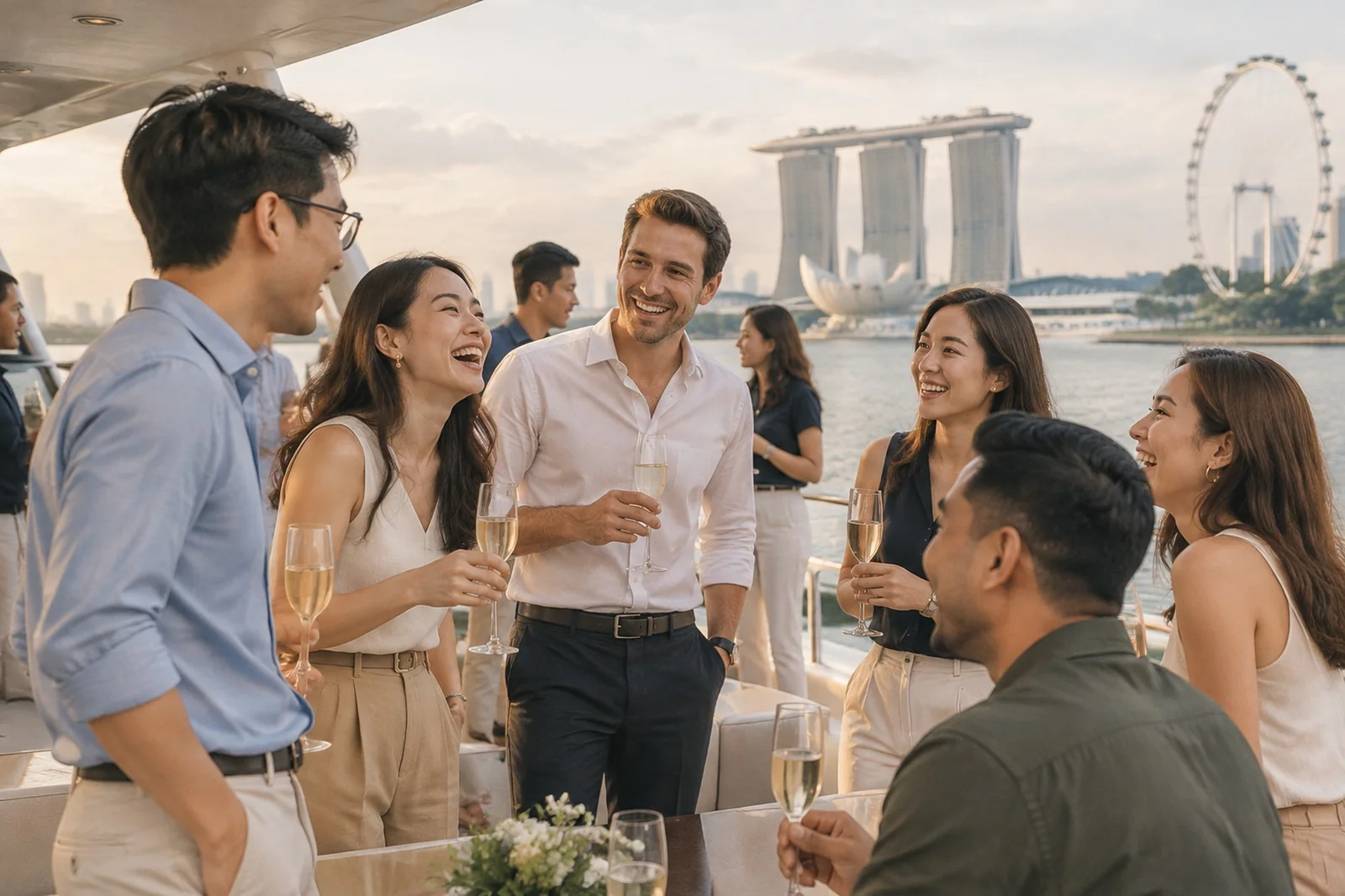
Most corporate team building in Singapore starts the same way: someone searches for “fun things to do”, collects a list of venues, and then discovers that a 30-person and a 300-person group are not the same programme.
This guide reverses the order. Start with the objective, then the format, then the group size, then the venue and budget.
1. Start with the objective, not the venue
Team building is not simply “taking everyone somewhere”. Different objectives need different designs:
- Ice-breaking: new teams, cross-department groups, post-merger integration. Low barrier, high interaction.
- Collaboration: project teams and regional teams. A shared task, not parallel activities.
- Recognition: sales teams and annual achievers. A sense of occasion and a high-end experience.
- Reflection: leadership teams and project reviews. A quiet room, a good facilitator and a tangible output.
- Recovery: after an intense quarter. Do not fill every hour; space is part of the design.
Write the objective in one sentence before choosing a venue. If you cannot, the venue will make the decision for you — usually the wrong one.
2. Six formats that work
| Format | Group size | Duration | Best for | Why it works |
|---|---|---|---|---|
| Yacht team building | 30–150 | 3–5 hours | Reward, pre-gala | Private yacht, sailing, sunset dinner |
| City quest | 30–300 | Half day | Cross-team ice-breaking | Missions, points, the city as a board |
| Culinary workshop | 30–200 | 2–3 hours | Rainy-day option, full participation | Local chef, team cook-off |
| Sentosa adrenaline | 30–100 | Half day | Young or sales teams | MegaZip, Skyline Luge, obstacles |
| Creative studio | 20–150 | 2–3 hours | Review, alignment, leadership | Improv, sandbox, facilitated output |
| Gala dinner | 50–500 | Evening | Annual meeting, awards | Team building and dinner in one |
A few practical notes:
- Yacht programmes have the highest experience density, but they are sensitive to seasickness, age and weather. Collect fitness information and prepare a land alternative.
- City quests work best for 100+ guests. Split into teams of 8–12 and use a points table; the group will not bunch up.
- Culinary workshops are the most reliable rainy-day format and the easiest way to mix international and local teams.
- Sentosa adrenaline is not for everyone. Design it as “optional challenge + ground-level collaboration” rather than forcing the whole group onto the course.
- Creative studios are about output, not noise. Use them for leadership retreats or project reviews, with a facilitator who can hold the room.
- Gala dinners are not “booking a restaurant”. Stage, awards, performances, menu and flow need to be run like a show.
3. Choose by group size
10–30 guests: half-day light programme
Two or three activities plus lunch, focused on ice-breaking and collaboration. Good before or after a quarterly or regional meeting. At this size, spend the budget on experience and food, not elaborate staging.
30–100 guests: full-day programme
Outdoor challenge in the morning, indoor workshop or review in the afternoon, dinner in the evening. Coaches, safety officer and AED-certified staff. Two or three settings in one day is the most comfortable rhythm.
100–300 guests: multi-day retreat
Rotating groups: A outdoor, B water, C workshop, rotating by time slot. Close with a themed dinner. The key is not “more activities” but flows that do not collide: coaches, assembly, meals, restrooms and wet-weather backup areas all need to be drawn in advance.
300–500 guests: large corporate group
Split venues, batches and flows. Venue availability, catering production, transport dispatch and safety plans need a longer lead time. Start 8–12 weeks ahead and write the control desk and radio plan into the proposal.
4. How the budget is built
Team building costs usually include:
- Activity delivery (facilitators, equipment, set-up, insurance)
- Venue (hotel, attraction, yacht, workshop)
- Catering (lunch, dinner, coffee breaks, drinks)
- Transport (airport transfers, day charter, coach dispatch)
- Crew (project manager, bilingual host, photography, safety officer)
- Collateral (apparel, badges, prizes, welcome gifts)
A common planning split is 40–50% activity and venue, 20–30% catering, 10–15% transport and 10–15% crew and collateral. The actual mix varies widely. Instead of asking “what is the cost per person?”, give the group size, dates, duration and desired atmosphere, and ask for an itemised range.
5. A three-day, two-night reference itinerary
Day 1 — arrival, check-in, welcome dinner
Airport meet-and-greet, hotel check-in, welcome dinner. The project manager aligns the next two days on site.
Day 2 — team building, awards dinner
Morning team building, afternoon free time or a facilitated review. In the evening, the annual meeting or awards dinner brings the day into one room.
Day 3 — city experience, departure
A curated city experience or company visit, then a group airport transfer.
With two days, compress to “Day 1 team building + dinner, Day 2 city experience + airport”. If the group is mainly in Singapore for a meeting, put the team building after the meeting rather than before — the group is already in the same rhythm.
6. Weather, safety and the things people forget
Singapore is rainy. Outdoor programmes should have indoor fallbacks by default. The delivery team switches based on the day's conditions rather than cancelling.
Water, aerial and sports activities should be run by licensed suppliers with professional equipment and safety crews. Activity insurance is configured per programme.
Before the event, collect allergies and dietary requirements, fitness restrictions, emergency contacts and passport details if boarding a yacht or entering a restricted venue. This is not paperwork; it will be used on the day.
7. FAQ
Can you run a programme for fewer than 30? Yes. 10–30 guests suit a half-day programme: two or three activities plus lunch, focused on ice-breaking and collaboration.
How far ahead should we plan? 30–100 guests: 4–6 weeks. 100–300: 6–8 weeks. 300+: 8–12 weeks. Chinese New Year, May, summer, National Day and year-end are peak periods; venues and hotels should be locked earlier.
What if it rains? Outdoor programmes have indoor fallbacks. The team checks the weather window before the event and switches or re-orders activities on the day.
Can we book team building without a meeting or hotel? Yes. You can also hand the meeting, hotel, transport and dinner to the same team for fewer interfaces.
Do we need a local delivery team? Above 50 guests, yes. Venue, transport, catering, insurance and on-site contingency all have to work at the same time. The value of a local team is that someone is on site when something changes.
Start with the group, not the venue
G K TRAVEL PTE. LTD. was founded in Singapore in 2016. It holds the STB highest-level travel agent licence, is a NATAS member and was named a Singapore SME 500 company in 2025. The GK MICE team has served 3,000+ corporate and MICE clients and 100,000+ guests.
- Team building formats: https://www.gkmice.com/en/team-building/
- Start an enquiry: https://www.gkmice.com/en/contact/
- WhatsApp: +65 8303 8023
- Singapore: +65 9025 7976
- China: +86 157 1284 9551
- Email: gktravelpteltd@gmail.com