
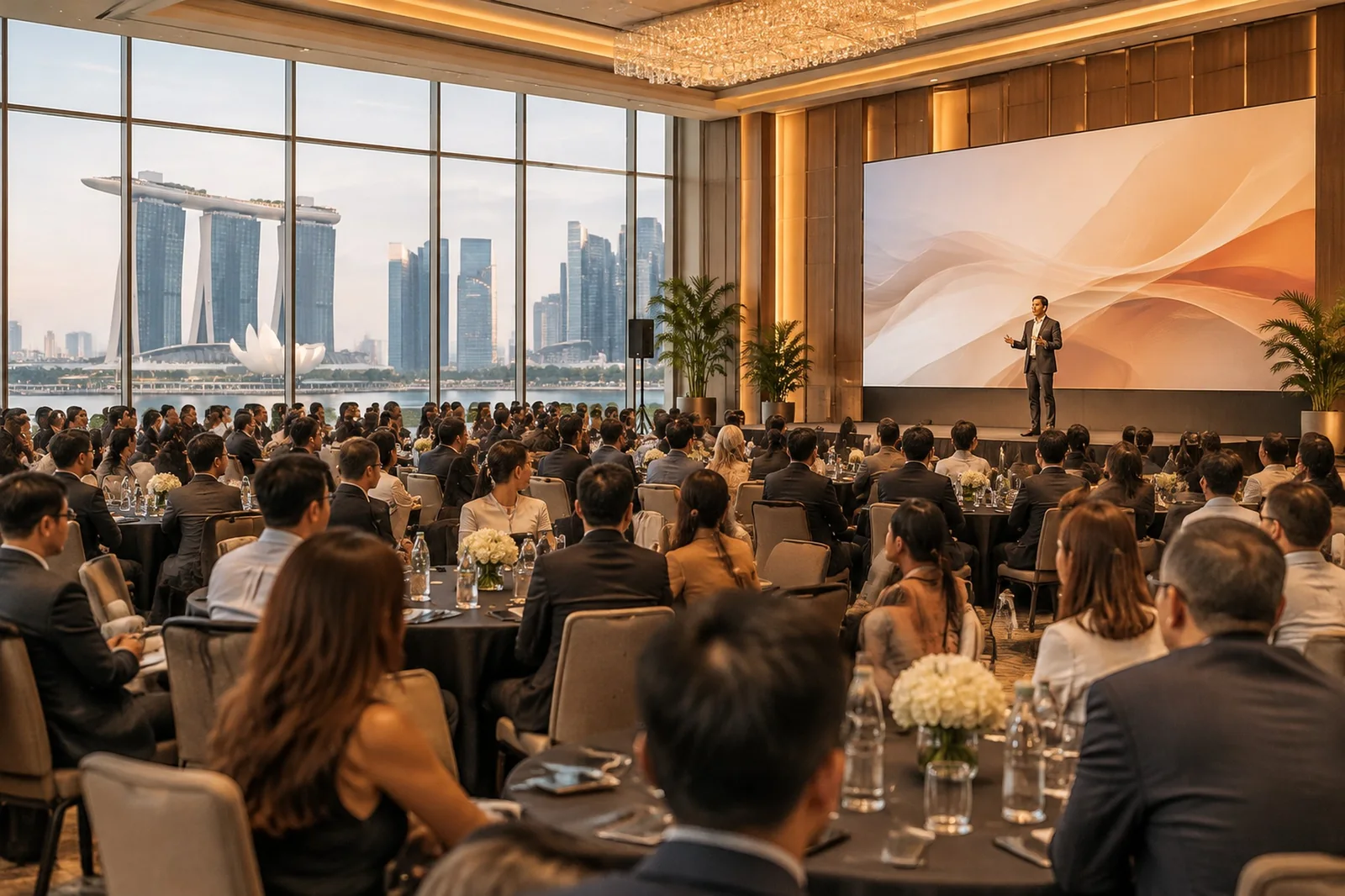
A 300-person Singapore annual meeting usually involves six supplier categories: venue, staging, catering, accommodation, transport and guest coordination. The corporate team ends up in a dozen email threads and still has to decide whose version of the truth is correct.
Full-service MICE delivery is not “one more supplier”. It is one project manager who owns every interface. This article explains what that covers, how it is priced and how the on-site system works.
1. MICE is four different rooms
- Meeting: industry meetings, forums, launches. Agenda, guests, staging and registration.
- Incentive: reward travel for top performers. Hotels, exclusive experiences and a sense of recognition.
- Conference: dealer conferences and annual meetings. Plenary, breakouts, multi-day hosting and awards.
- Exhibition: exhibition hosting, stand build, show-period transport and guest flow.
They share one thing — many people in one place at one time — but the flow, rhythm and risks are different. A single template applied to every event will fail on the day.
2. What full-service actually covers
| Workstream | What it includes |
|---|---|
| Venue | Convention centres, hotel ballrooms, unique venues, outdoor and waterfront spaces |
| Catering | Chinese, Western, buffet, halal, vegetarian, cocktails and gala menus |
| Staging & AV | Stage, lighting, sound, LED, registration and exhibition stands |
| Accommodation | Group rooms, VIP rooms, early check-in / late check-out and rooming management |
| Transport | Airport transfers, corporate fleets, coach dispatch and driver management |
| Crew | Project managers, bilingual hosts, interpreters, photography and ushers |
| Registration | Sign-up, lists, check-in, badges, seating and rooming |
| Contingency | Weather, medical, flights, equipment and staffing plans |
You can take the full scope or a single segment: the annual dinner, the incentive trip, the exhibition hosting or the transport.
3. The five-step delivery process
Step 1: Brief. Objective, group size, dates, budget, venue preferences and special requirements. Align the objective before discussing resources.
Step 2: Proposal and budget. Two or three routes, itemised costs, clear inclusions and exclusions. A first proposal usually takes 3–5 business days.
Step 3: Venue and supplier confirmation. Availability, contracts and supplier lock-in. Minimum spend, access and build rules are confirmed in writing at this stage.
Step 4: Pre-event coordination. Rooming, transport, collateral, guests and on-site flow. Every key item is checked off.
Step 5: On-site delivery and review. PM on site, bilingual crew, contingency plans; after the event, feedback, photography and a final cost sheet.
4. Choosing the right venue
Singapore is dense with venues, but every one has minimum spend, access times and build restrictions. Choose the venue after the event, not from a photograph.
- Convention centres: Marina Bay Sands Expo, Suntec Singapore, Singapore Expo. For 300+ guests needing a plenary, breakouts and exhibition space.
- Hotel ballrooms: Fullerton, Raffles, St. Regis, Shangri-La, RWS. For events that need catering, stage and accommodation in one place.
- City landmarks: Gardens by the Bay, National Gallery, ArtScience Museum. Strong sense of place, stricter build and catering rules.
- Waterfront and outdoor: ONE°15 Marina, Sentosa Cove, Keppel Bay, Sentosa. For light builds and experience-led programmes.
Venue availability is subject to confirmation. We do not promise to “hold” a date before a contract is signed.
5. How the budget splits
A planning reference, not a quote:
- Venue: 25–40%
- Catering: 25–35%
- Staging / AV: 15–25%
- Transport / accommodation: 10–20%
- Delivery crew: 10–15%
Actual percentages depend on group size, venue grade, catering standard, build complexity and season. Itemising the budget lets you see where the money goes and choose where to trade off.
6. The Pro-MICE delivery system
- Dedicated on-site PM: one project manager from pre-event coordination to close-down. Decisions happen on site.
- Bilingual crew: English / Chinese project managers and crew, with sector-aware bilingual hosts.
- ABC contingencies: plans B and C are prepared before the event. Weather, equipment, flights or staffing changes switch according to the plan.
- Medical contacts: direct contacts with local medical providers; urgent cases are referred through an established process.
- Stop-work mechanism: the PM can stop any element that becomes unsafe or unacceptable and switch to an alternative.
7. Planning rhythm
- 30–100 guests: 4–6 weeks ahead
- 100–300: 6–8 weeks ahead
- 300+: 8–12 weeks ahead
- Peak season (Chinese New Year, May, summer, National Day, year-end): 2–4 weeks earlier
Urgent projects can be accelerated, but venue and hotel options shrink. We will flag timing risk in the proposal.
8. FAQ
What is the difference between full-service and individual bookings? Individual booking covers one element. Full-service delivery gives one project manager responsibility for venue, catering, staging, transport, crew and contingency — fewer interfaces and clearer accountability.
What group sizes can you handle? Regularly 50–500; 1,000+ can be delivered with convention centres and supplier partners. The larger the group, the more critical the lead time and venue choice.
Can we book only the annual dinner? Yes. You can also book only a meeting, incentive trip, exhibition hosting or corporate transport.
Can we settle in Singapore? Yes. Contracts and settlement are with the Singapore entity; invoices are available. Cross-border payment and terms are confirmed per project.
Send the goal, group size and dates
G K TRAVEL PTE. LTD. was founded in Singapore in 2016. It holds the STB highest-level travel agent licence, is a NATAS member and was named a Singapore SME 500 company in 2025. GK MICE has served 3,000+ corporate and MICE clients.
- MICE services: https://www.gkmice.com/en/mice/
- Start an enquiry: https://www.gkmice.com/en/contact/
- WhatsApp: +65 8303 8023
- Singapore: +65 9025 7976
- China: +86 157 1284 9551
- Email: gktravelpteltd@gmail.com